
10 days in Italy by train: a resident's itinerary
Last updated on May 20th, 2026.
The first time I took the Frecciarossa from Rome to Florence I thought, this is how Italy is meant to be seen.
Not from a tour bus window. Not from a cramped rental car navigating a ZTL zone you didn't know existed. From the train.
In this guide, I'll give you a complete, day-by-day 10 days in Italy by train itinerary. Built on 10+ years of living between northern Italy and Sicily, it’s a relaxing, and scenic, way to travel.
This guide is perfect if:
- you're deciding between a 7-day vs. 10-day Italy trip
- wondering how to plan a trip to Italy on your own
- you're trying to understand which train routes are worth the cost.
What you'll learn:
- The best 10-day Italy train route for first timers
- How to book Italian trains without getting burned
- Italian rail planning masterclass (2026 edition)
- Day-by-day breakdowns
- Budget tables
- Packing tips, and
- Three alternative route options.
Jump to:
- 7 days vs. 10 days in Italy by train: which is right for you?
- The best 10-day Italy train route
- The Italian rail masterclass: everything you need to know in 2026
- Day-by-day breakdown: your 10-day Italy itinerary by train
- How to book Italian trains: route-by-route planning
- Luggage, packing and train travel
- How much does a 10-day Italy trip by train cost?
- Traveling with kids and babies on Italian trains
- Practical tips for boarding Italian trains
- 7 mistakes to avoid on your Italian train trip
- Beyond the classic route: 3 alternative 10-day Italy train routes
- FAQs on 10 days in Italy by train
- 💬 Comments
7 days vs. 10 days in Italy by train: which is right for you?
A 7-day Italy itinerary covers the classic Rome, Florence, Venice triangle but feels rushed. 10 days gives you the same cities with time to breathe, plus one wild-card destination. Think, Cinque Terre, the Amalfi Coast or Siena. For a first visit, 10 days is the minimum I recommend.
The 'Italy itinerary 7 days' search is one of the most popular travel queries I see, and I understand why. Seven days feels manageable.
But Italy isn’t manageable in seven days. Instead, it rewards slowness.
The train network is so efficient that it's tempting to cram in more cities. One of the most popular routes, Rome to Florence, takes 1hr 30 mins on the Frecciarossa high-speed service.
With 10 days, you’ve enough time to experience each place. Find a local bar, get lost in a neighborhood, or eat in a place that doesn't have a photo menu.
| 7-day trip | 10-day trip | |
| Cities covered | 3 (Rome, Florence, Venice) | 4 to 5 (+ Cinque Terre or Siena) |
| Pace | Rushed (2 nights per city) | Relaxed (2 to 3 nights per city) |
| Train journeys | 3 to 4 total | 5 to 7 total |
| Best for | Weekend getaways, return visitors | First travelers, slow travelers |
| Budget (accommodation) | Lower total spend | Slightly higher, far more rewarding |
The best 10-day Italy train route
After taking plenty of train trips across Italy, this is the route I recommend to first-time visitors.
It balances iconic must-see places with the kind of unhurried exploration that makes Italy unforgettable.
| Days | City/region | Train route | Approximate journey time |
| 1 to 3 | Rome | Arrival (fly into FCO or CIA) | N/A |
| 3 to 5 | Florence | Rome Termini to Firenze S.M.N. | 1hr 30mins (Frecciarossa) |
| Day 5 (day trip) | Siena | Firenze S.M.N. to Siena | 1hr 30mins (regional) |
| 5 to 7 | Cinque Terre | Firenze to La Spezia to Monterosso | approximately 2.5 hours/22 minutes |
| 7 to 10 | Venice | La Spezia to Venice Santa Lucia | approximately 5hrs 20mins |
| Day 10 | Depart | Venice to Marco Polo Airport | Bus/Alilaguna boat |
Note: all journey times are approximate and based on high-speed Frecciarossa or Intercity services. Regional trains to Siena and within Cinque Terre operate on separate schedules. Always verify current timetables on Trenitalia.com or Italo.it before booking. Prices and schedules change seasonally.
Interactive map: 10 day in Italy by train
Follow the full 10-day itinerary on the map below. It includes every train station, recommended neighborhood and major attraction, plotted in order.
Use it to get a feel for the geography before you travel. Don’t forget to save it to your Google Maps app on your phone for the trip.
⏩️ Read the full list of Italy travel apps that I personally use, which will ensure your vacation goes smoothly.
The Italian rail masterclass: everything you need to know in 2026
For years, the green machine on Italian platforms was the most confusing object in train travel.
Miss it, and you could face a €50 fine (if paid on the spot) even if your ticket was valid. The rules have evolved, but not uniformly. Here’s the definitive breakdown.
| Ticket type | How you buy it | Do you need to validate | How |
| High-speed (Frecciarossa/Italo) | App, website or machine | NO | Your seat reservation PNR code IS your validation. Inspectors scan it digitally. |
| Regional, digital ticket | Trenitalia, Italo, Trainline, Omio app | NO (as of late 2024) | The app auto-validates at your scheduled departure time. No manual check-in needed. |
| Regional, paper ticket | Machine or ticket window | YES, mandatory | Stamp in the green machine on the platform before you board. No stamp = €50 fine (if paid immediately), no exceptions. |

📌 Lisa’s tip: If you’re in any doubt whether your ticket needs validating, validate it. Inspectors aren’t sympathetic to 'I didn't know.' If you bought digitally via the Trenitalia app, you're covered. If you’ve a paper ticket from a machine: green machine first, train second.
Trenitalia vs. Italo: which should you book in 2026?
These are Italy's two high-speed rail operators competing on the main route of Rome, Florence, Milan and Rome to Naples.
In 2026, Italo expanded its fleet with more frequent Executive and Smart class departures.
Here's how to choose:
| Factor | Trenitalia (Frecciaross) | Italo |
| Network coverage | Nationwide, Frecciarossa too | High-speed line only (no regional) |
| Price | Comparable, check both | Often cheaper with advance booking |
| Loyalty discounts | Cartafreccia program | 'Italo Più’, up to 30% off 2 weeks ahead |
| Eurail Pass valid? | Yes (+ seat reservation fee) | No, not valid on Italo |
| Best for? | Regional connections + flexibility | Milan, Florence, Rome, Naples line |
| Booking | Trenitalia app/website | Italo.it/Italo app |
Third-party aggregators like Omio, Rail Europe and Trainline add booking fees on top of the base fare. If you’re on a budget, always book direct.
📌 Lisa’s tip: I use the Trenitalia app for regional connections (Tuscany, Cinque Terre, Umbria) and the Italo app for high-speed routes. Italo Più loyalty discounts can save 30% if you book just two weeks out. I've paid as little as €19 for Florence to Rome on a Wednesday afternoon. Check both before committing.
How far in advance should you book Italian trains?
For high-speed Frecciarossa and Italo trains, book 3 to 4 months ahead for the lowest Super Economy fares. These can be up to 60% cheaper than walk-up prices. Regional trains (Siena, Cinque Terre villages) are fixed-price and cannot be reserved. Buy these on the day at the station.

The Italy train pricing model mirrors airline tickets: early = cheap, last-minute = expensive. The Super Economy fare on Trenitalia is non-refundable and non-changeable: only buy it if your dates are fixed.
The Economy tier (slightly pricier) allows changes but for a fee.
Day-by-day breakdown: your 10-day Italy itinerary by train
Days 1 to 3: Rome
Fly into Rome Fiumicino (FCO), the largest international airport in Italy, if you can.
Get the Leonardo Express direct to Roma Termini (32 minutes, currently €14*). Rome needs at least two full days, ideally three.
The Vatican Museums and the Colosseum will each take up a full day if done properly.
Book timed entry tickets in advance for the Vatican Museums and the Colosseum as soon as you’ve booked your trip. Tickets typically sell out for popular attractions in Italy, and two-hour queues aren’t a rarity in Rome in July.

When deciding on where to stay in Rome, choose a neighborhood like Prati (north of the Vatican) or Testaccio.
You usually pay less in these residential neighborhoods and feel like you're in Rome rather than a theme park. Avoid hotels directly around Roma Termini station.
On your third morning, take the Frecciarossa to Florence. The Rome to Florence train is one of Europe's most-searched rail journeys.
Unsurprisingly, tickets sell out fast in peak season.
Days 3 to 5: Florence
Florence took me three visits to fully appreciate it.
On the first, I was overwhelmed by the art density. On the second, I discovered Oltrarno, the neighborhood on the 'wrong' side of the Arno, and everything changed. Stay here.
See where to stay in Florence for hotel recommendations in Oltrarno.
Like Rome, book popular Florence attractions like the Uffizi Gallery and the Accademia (Michelangelo's David) well in advance.

The Bargello Museum contains some of Donatello's finest work with a fraction of the crowds. It’s one of Florence's best-kept secrets.
On Day 5, leave your bags at the hotel and take the regional train to Siena for a day trip.
Piazza del Campo is probably the most beautiful public square in the whole of Italy.
Eat handmade pici at an osteria like Osteria Il Carroccio on the edge of the campo. You won’t regret it.
Days 5 to 7: Cinque Terre
Take the train from Florence to La Spezia Centrale, then Cinque Terre Express to your village.
Read the 2026 changes for the Cinque Terre Express in my guide on How to take trains in Italy.
I recommend staying in Vernazza or Corniglia. Both are slightly less touristy than Monterosso al Mare or Riomaggiore.
The Cinque Terre Card is ideal for unlimited train hops, but prices change according to the season.
In 2026, 1-day adult passes cost:
- Green season: €19.50* (March, beginning of April and some weekdays in May and October)
- Yellow season: €27.00* (April, June, September and certain weekdays in July and August)
- Red season: €32.50 (public holidays in Italy (May 1st, June 2nd) and weekends in July and August.)
Lisa’s tip: the Sentiero Azzurro coastal path is partially closed at various points throughout the year due to landslide risk. Always check the trail status at the official Parco Nazionale delle Cinque Terre website before you go.
Days 7 to 10: Venice
When the doors of Santa Lucia train station open and you first see the Grand Canal, you’ll feel something shift.
Venice is best understood not as a city but as a performance.
As a Veneto local, three nights is an ideal stay for a first visit.
It gives you ample time to see St. Mark's Basilica and bell tower (go at the opening) and Doge’s Palace.

Browse the produce at Rialto Market (Tuesday to Saturday mornings) and enjoy getting lost in Cannaregio and Castello.
These are two areas (residential sestieri) that most tourists never reach. Not only are they more local, but they also make great choices when looking for where to stay in Venice.
📌 Lisa’s tip: The Venice access fee (Contributo di Accesso (day-visitor entry fee)) came into effect in 2024. Typically, it runs from April to the end of July every year. If you’re planning on staying in Venice, you’re exempt from paying as your hotel tax will cover it. However, be sure to ask your hotel for proof (email, QR code) when exploring Venice. You might be asked to show it at one of the inspection points if visiting during this period.
My guide on 11 things to know before visiting Venice covers this topic in more detail.
How to book Italian trains: route-by-route planning
Book Italian high-speed trains directly on Trenitalia.com or Italo.it. Buy 3 to 4 months ahead for Super Economy fares. Regional trains (Siena, Cinque Terre) are fixed-price, require no advance booking and you can buy them on the day.
| Route | Operator | Approximate journey | Booking strategy |
| Rome to Florence | Trenitalia/Italo | 1hr 30mins | Book 3 to 4 months ahead, check both operators |
| Florence to La Spezia | Trenitalia | 1hr 30mins (regional) | Fixed regional fare, buy on the day |
| La Spezia to Cinque Terre villages | Cinque Terre Express | 22 minutes | Buy Cinque Terre Card at La Spezia station |
| Florence/La Spezia to Venice | Trenitalia/Italo | approximately 2.5 hours | Book in advance, Italo is often cheaper |
| Rome to Siena (and back, day trip) | Trenitalia regional | 3hrs 20mins | No reservation, fixed price, day-trip only |
Prices and timetables are correct as of April 2026. Verify all fares and schedules on Trenitalia.com or Italo.it before booking. Following the Rivera is not affiliated with any rail operator.
Luggage, packing and train travel
Why your luggage choice could make or break your trip
Italian trains have overhead racks, but they’re narrow, significantly narrower than what north American travelers expect.
A full-size check-in suitcase (67 to 75cm) will not fit overhead. It goes in the rack at the end of the carriage, out of your line of sight.
The one-bag rule
I travel Italy with a 40L carry-on bag that fits overhead on every train, every time. I’ve brought it from Milano Centrale to my hotel without wheels, without elevators and without drama. If you're spending 10 days in Italy by train, it’s the most important packing decision you'll make.
If you must bring a larger suitcase, use a small cable lock to secure it to the luggage rack.
Theft on Italian trains is rare but not unheard of. A cable lock provides peace of mind while you're in the restaurant or asleep on a night service.

First-timer packing list for Italy by train
These are items that experienced train travelers carry that first-timers wish they had.
Portable power bank: even in 2026, seat outlets on regional trains are unreliable. Many older Regionale carriages have no outlets at all. A 10,000mAh bank will cover your phone and e-reader for a full day.
Noise-cancelling headphones: essential for long journeys (Venice to Rome is around 4 hours).
The hand-carry bag: a small crossbody or daypack for your passport, wallet, water and snacks. Never leave this in your seat when you walk to the restaurant or to the toilet. Keep it on you at all times.
Eurail timetable app backup: the Trenitalia app handles real-time platform announcements (the binario (platform number)) often appears only 10 minutes before departure). But apps fail. Know your train numbers in advance.
Travel scarf or light layer: Italian train air conditioning is set to maximum In July. If you’re like me and always get a chill, you’ll thank me for this one!
How much does a 10-day Italy trip by train cost?
A mid-range 10-day Italy trip by train costs approximately €2,500 to €4,000 per person (excluding flights). Budget travelers can do it for €1,500 to €2,000; luxury travelers should budget €5,000+. Train costs for the full itinerary run approximately €100 to €200 per person, booked in advance.
| Category | Budget (per person) | Mid-range (per person) | Luxury (per person) |
| Flights (round-trip) | €300 to 500 | €500 to 900 | €1,500+ |
| Accommodation (9 nights) | €450 to 700 | €900 to 1,500 | €2,500+ |
| Train fares (all legs) | €100 to 150 | €130 to 200 | €200+ (1st class) |
| Food and dining (daily average) | €30 to 40/day | €60 to 80/day | €120+/day |
| Entry tickets (museums etc) | €80 to 120 total | €100 to 150 total | €200+ (private tours) |
| Miscellaneous (transport, souvenirs) | €100 to 150 | €150 to 250 | €300+ |
| TOTAL (approximate) | €1,500 to 2,000 | €2,500 to 4,000 | €5,000+ |
Traveling with kids and babies on Italian trains
Italian trains are genuinely one of the best ways to travel with young children.
There are no confining car seats, no motorway service stations and less chances of a meltdown.
I say this as a mamma who has done the Venice to Rome run with a baby in a stroller and a packet of Oro Saiwa cookies. It’s manageable, memorable and never dull. It can even be wonderful, at times!
That said, there are a few things worth knowing before you board with little ones. I’ve a full guide on traveling in Italy with a baby, linked below, but here are the essentials specific to train travel.
Strollers, prams and the space question
High-speed Frecciarossa trains have a designated multi-purpose area near the doors of certain carriages. This is where you can park a pram without blocking the aisle.
When booking, look for seats near carriage doors. It’s not always clear when booking online or through an app. Instead, book at a station window and ask for a seat near the luggage area (un posto vicino al bagagliaio).
Honestly, I wouldn’t recommend traveling with a pram on trains in Italy. A compact, foldable stroller is much more compact and convenient for train journeys. Overhead racks won’t accommodate a pram frame so don’t even attempt it.
Feeding, naps and the restaurant
Regional trains have no restaurant car. High-speed Frecciarossa and Italo trains do, but the food’s overpriced and the menu is limited.
I advise bringing your own snacks for the children and bringing more than you think you need.
The journey from Florence to Venice is around 2hrs 15mins on a direct service. That’s approximately two to three snack cycles for a toddler.
📌 Lisa's mamma tip: If you're traveling with a baby on Frecciarossa trains who needs warm milk or food, ask a member of staff in the cafe/restaurant. Many are accommodating, can speak basic English and will warm up milk or food in the microwave (if available). This is a kindness, not a policy so always ask first.

Noise, space and fellow passengers
Many Italians are (usually) very tolerant of children on public transport.
A crying baby on an Italian train is likely to attract sympathetic smiles over death stares, so don’t stress about this.
What Italians are less tolerant of is loud electronic devices without headphones. Make sure you pack child-friendly headphones for tablets or keep the volume low.
For the full picture, including what to pack and most baby-friendly cities, read my guide on 'How to travel in Italy with a baby.'
Seat reservations and ticket strategy
- Children under 4 travel free on Trenitalia (under 3 on Italo) and don’t require a seat, they sit on a parent's lap.
- Children aged 4 to under 15 qualify for a 50% discount on Trenitalia high-speed trains. There are no discounts on regional trains.
- Book a four-seat facing cluster (quattro posti vis-à-vis) where possible. The table between the seats is ideal for snacks, coloring books and containing the general chaos of traveling with small people! These should be visible when selecting seats in the Trenitalia app.
Practical tips for boarding Italian trains
This is the section that separates experienced Italian train travelers from first-timers.
The logistics of getting on the train are just as important as the booking. Read this before your first departure.
Allow more time than you think at the station
Italian high-speed stations (Roma Termini, Firenze S.M.N., Venezia Santa Lucia) are large and busy.
Allow at least 30 minutes before departure to navigate the station, find your platform and board comfortably.
The platform number (binario) for high-speed trains typically appears on the departures board only 10 to 15 minutes before departure. This is normal, don’t panic. Watch the board, then go to your platform when it appears.
📌 Lisa’s tip: If you’re traveling with children, heavy luggage or anyone with limited mobility, factor in 45 minutes. Finding a platform at the far end of Roma Termini with a stroller and a toddler isn’t the adventure you want!
Validate if you need to before you reach the platform
My apologies for sounding like a broken record, but give yourself enough time to validate your paper ticket.
You’ll see the green validation machines inside the station and typically at platform entrances, they’re not always on the platform.
Bring your own snacks or buy at the station
Tabaccherie, bars and mini-supermarkets inside Italian train stations sell perfectly good food, many at reasonable prices.
While they’ll still be higher compared to outside places, they’re still better value than buying on the train. Stock up before boarding especially if you’re on a budget.
What to bring on a long train journey
- Water: at least one liter per person on journeys over 90 minutes. Train air conditioning can be dehydrating.
- A proper snack, not just cookies: opt for something like a panino or a tramezzino (crustless sandwich).
- Something for the journey: books, tablets or a sleeping mask. Use the train journey time to sit back and relax.
- A reusable bag: it’s likely you’ll buy things at markets and shops along the way. Having a tote bag means not having to juggle loose items on a moving train.
- Wet wipes and tissues: being a mamma means I never go anywhere without bringing baby wet wipes. But, they also come in super handy when taking Italian trains. Bathrooms aren’t always spotless, so plenty of wipes and tissues are handy for both babies and parents.
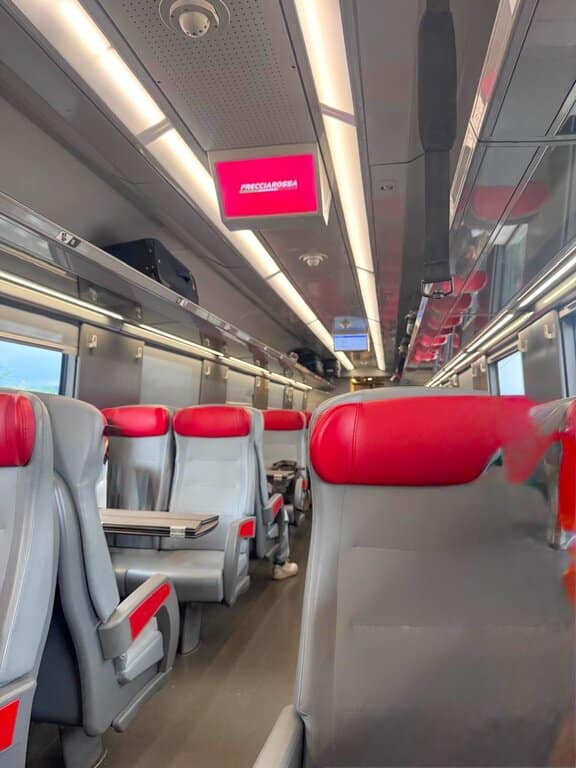
Finding your carriage and seat
Your ticket shows your carriage number (carrozza) and seat number (posto).
On the platform, look for the yellow carriage position markers on the ground. These show where each carriage will stop when the train pulls in.
Walk to your carriage marker before the train arrives rather than scrambling along the platform once it does. It’s especially important if you’re traveling with luggage or children.
📌 Lisa’s advice for first-timers: when the train pulls in, everyone scrambles toward the nearest door. Don’t follow them. Instead, find the carriage position marker for your carrozza number, wait there and board calmly. Leave everyone else to elbow past each other three carriages down.
What to do If your train Is delayed or canceled
Italian high-speed trains are generally punctual, but delays happen.
If your train is delayed by more than 30 minutes, Trenitalia's refund (rimborso) policy entitles you to a partial refund. The same applies to Italo.
Keep your booking confirmation. If you miss a connection due to a delay, go to the assistance (assistenza) desk immediately. Don’t simply re-book online: you may be entitled to re-booking assistance at no extra cost.
7 mistakes to avoid on your Italian train trip
1. Not booking museum tickets in advance
The Uffizi Gallery and the Borghese Gallery have a strict timed entry, with a maximum of 15 people per room.
You’ll either spend your entire morning in a queue if you don’t have a reservation or won’t get in at all. Book as soon as you’ve booked your trip, more so if visiting in summer.
2. Skipping breakfast at a bar
Some hotel breakfasts in Italy can be disappointing, not to mention costly.
Instead, do as we do and find a local bar or better yet, a pasticceria. Stand at the counter, order a cornetto/brioche and cappuccino and pay around €3.50.

Sitting down at a tourist-area cafe can double, or sometimes even triple the price. This isn’t a scam; it’s legal, displayed on menus and is entirely avoidable.
Want to avoid real scams in Italy? Read this before visiting.
3. Confusing Trenitalia and Italo (especially with a Eurail Pass)
Italo is the private operator (often cheaper on high-speed routes), while Trenitalia is state-owned with broader regional coverage.
Your Eurail Pass is valid on Trenitalia with a seat reservation surcharge but NOT valid on Italo. Check both before booking every leg.
4. Getting the validation rule wrong
If you buy a paper ticket from a machine, always validate it in the green machine before boarding. Miss this and the fine is €50 (if paid on the spot). Inspectors won’t accept 'I didn't know' as an excuse.
With digital tickets, the app auto-validates them. Make sure to have the app or email/QR code to show the inspectors.
Booked a high-speed Frecciarossa or Italo service with a seat reservation? Your PNR code is your validation, no machine is needed.
5. Staying too central in Venice
Cannaregio is around a 20-minute walk from Santa Lucia station. It’s residential, beautiful and genuinely Venetian.

The closer you stay to Piazza San Marco, the more you pay and the less of the real Venice you experience.
6. Underestimating afternoon closures
Many churches, smaller museums and local shops close between 1pm and 3:30 to 4pm.
Plan your sightseeing around these hours. Use mornings for the big sights, early afternoon for lunch and a rest, and late afternoon for the next destination.
7. Overpacking (see luggage section above)
A check-in suitcase on Italian trains can be a burden. You also must deal with cobblestone streets, narrow hotel lifts and smaller luggage racks.
Traveling with a 40L bag makes it a smoother experience.
Beyond the classic route: 3 alternative 10-day Italy train routes
The Rome, Florence, Cinque Terre, Venice itinerary is the best first-timer route. But Italy's rail network is huge.
Here are three alternative 10-day train journeys you can realistically do in the same period.
Route 1: Venice, Florence, Rome
The classic route but in reverse.
Start in Venice (fly into Marco Polo Airport). Take the Frecciarossa south to Bologna (1 hour), then Florence (2 hours total) and finally onto Rome.
The advantage: you fly home from Rome (FCO) and end your trip on a high cultural note. Add a half-day in Bologna, the best food city in Italy, and the most underrated stop on the high-speed line.
Route 2: Milan, Lake Como, Lake Garda, Verona
Fly into Milan Malpensa and take the regional train to Como (50 minutes). Spend 2 to 3 days on Lake Como.
Take the train to Desenzano del Garda (Lake Garda's rail station) for 2 nights. Visit one or two nearby towns like Sirmione and Bardolino.

⏩️ See '1 day in Lake Garda' for alternative itineraries.
Continue to Verona (30 min) for 2 nights. See the Arena di Verona, Juliet's balcony and eat the best risotto all'Amarone of your life.
Return to Milan Malpensa to fly home. This route is less first-timer, more repeat visitor. It’s perfect for those who want an elegant trip over iconic sightseeing.
Route 3: Rome, Naples, Salerno, Sicily
Take the Frecciarossa from Rome Termini to Naples (approx. 1hr 10 mins) and spend 2 nights in Naples.
Eat a traditional Neapolitan-style pizza at a place that has little online presence then take the Circumvesuviana train to Pompeii. At just 30 minutes it makes an ideal half-day trip.
From Naples, the train to Salerno (45 minutes) connects to SITA buses for the Amalfi Coast. My 4-day Amalfi Coast itinerary is an easy starting point for first-time visitors.

For Sicily, take the overnight Frecciarossa to Palermo or fly Ryanair from Naples. I’ve taken this route once to visit our Italian family that live on the east coast and it’s a once-in-a-lifetime experience.
📌 Lisa’s advice: the southern route requires more flexibility than the north. Bus timetables on the Amalfi Coast are seasonal, and Sicily deserves at least 5 days on its own. I'd strongly recommend splitting a 20-day trip rather than trying to cram Sicily into 10 days.
Quick reference: important facts for trip planning
The following summaries pull together the most important planning points from this guide in one place. It’s useful if you're mid-planning and need a fast answer.
Route overview
The optimal 10-day Italy itinerary by train follows a route heading in a northern direction. 3 nights in Rome, 2 nights in Florence (with a Siena day trip), 2 nights in Cinque Terre and 3 nights in Venice.
High-speed Frecciarossa or Italo services connect larger cities (Rome to Florence: 1hr 30mins). Regional trains serve Siena and Cinque Terre. Total rail costs, booked in advance, are approximately €100 to €200 per person.
Booking and validation
Italian high-speed trains (Frecciarossa and Italo) are ticketless. Your PNR seat reservation code is your validation, scanned digitally by inspectors.
Regional paper tickets purchased from station machines must be stamped in the green validation machine before boarding (failure = €50 (on the spot fine).
Digital regional tickets bought via the Trenitalia app auto-validate at departure time as of the late-2024 update. Book high-speed trains direct on Trenitalia.com or Italo.it.
Trenitalia vs. Italo
Italy's two high-speed rail operators are Trenitalia (state-owned, Frecciarossa) and Italo (private).
Both serve the Rome, Florence, Milan route. Eurail passes are valid on Trenitalia with a seat reservation surcharge but are NOT valid on Italo.
Italo's 'Italo Più' loyalty program offers discounts up to 30% when booking two weeks in advance. Trenitalia is the only operator for regional connections (Tuscany, Cinque Terre, Umbria).
Budget summary
A mid-range 10-day Italy itinerary by train costs approximately €2,500 to €4,000 per person. This excludes international flights but covers accommodation, inter-city rail, museums and dining.
Budget travelers who book in advance and eat locally can complete the same itinerary for €1,500 to €2,000.
Train travel for the full Rome–Florence, Cinque Terre, Venice route costs approximately €100 to €200 per person booked via Trenitalia or Italo.
FAQs on 10 days in Italy by train
Spend at least 3 days in Rome on a first visit. Two full sightseeing days (Vatican/Colosseum/Roman Forum) plus one slower half-day for Trastevere or the Borghese Gallery. Two nights is possible, but it leaves you feeling like you've only skimmed the surface.
Two nights and two full days is the minimum for Florence. Three nights is ideal if you want the Siena day trip and time to genuinely explore Oltrarno.
Three nights in Venice are ideal for first-time visitors. One day for St. Mark's and the central areas and one day for Rialto and a vaporetto round trip. Spend the last day getting intentionally lost in Cannaregio or Castello, residential neighborhoods that most tourists never reach.
Yes, it’s much cheaper to book in advance. High-speed trains (Frecciarossa and Italo) use airline-style dynamic pricing. Booking 3 to 4 months ahead on Super Economy fares can save up to 60% compared to walk-up prices. Regional trains to Siena, Cinque Terre and Umbria are fixed price and you can’t reserve them in advance.
The Trenitalia app is good for real-time tracking and digital tickets (the platform number (binario) usually appears 10 minutes before departure). Italiarail.com is excellent for English-speaking customer support if something goes wrong. For Italo trains, use the Italo app directly.
Yes. Use Regionale trains instead of high-speed where possible. They take longer, but fares are fixed and much lower. Florence to Pisa by regional train is approximately €9 and Pisa to La Spezia is similarly affordable. Budget travelers who book high-speed trains in advance and eat cheaply, can complete this 10-day itinerary for €1,500 to €2,000 per person.
For a 10-day trip with fixed dates, individual advance tickets will almost always beat the Eurail pass on price. The pass adds value for spontaneous travelers who don't book ahead. Eurail is valid on Trenitalia HS trains with a seat reservation surcharge; it’s not valid on Italo at all.
Ready to plan your Italy train trip? start here
A great Italy trip is all about balance. Wanting to see everything but staying long enough in each place to experience it.
Seeing Italy by train makes this possible. It puts you inside Italy's geography in a way that flying city-to-city never does.
You watch the suburbs give way to farmland, and the farmland give way to endless green hills.
If you’re ready to see Italy by train, use the following resources to start planning your vacation today.
Disclosure: This post may contain affiliate links, which means I may receive a commission if you click a link and purchase something that I’ve recommended. Thank you for your support.
Written by Lisa Rivera: Italy traveler and resident for 10+ years. First-hand researched for 2026.
Like this post? Pin it!


Comments
No Comments